
Ep. 64: Great for Corporate, Risky for Creators
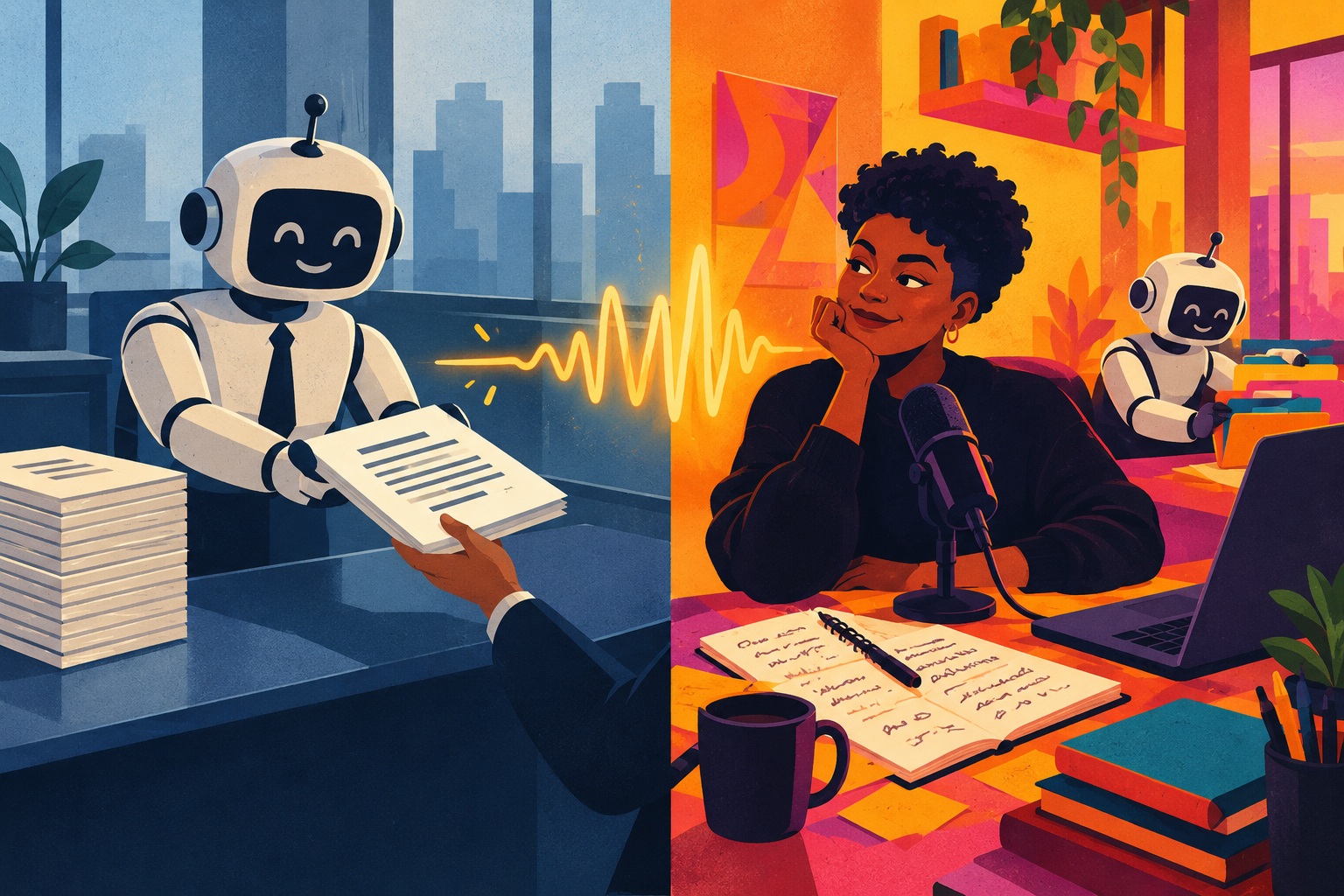
I recently used Claude to write an entire website proposal in about an hour, and the entire process revealed some pretty stark differences between corporate and creator AI use cases. In this episode I explain why outsourcing the final product is a great choice when the goal is convention, and an absolute no-no when convention is the goal is your voice.
A Few Quick Updates
Today we’re talking about a recent exposure I had to the corporate world and what it revealed to me about corporate vs creator AI use cases.
But real quick before we hop in, I want to share a few quick updates from the AI world:
Update 1: ChatGPT Is Retiring Custom GPTs
First up: ChatGPT is scheduled to retire custom GPTs on December 11th. They’re going to replace them with “Plugins.”
I wrote about custom GPTs back in episode 11, WTF is a Custom GPT?, and I’ll say it again: I think these were one of the coolest and most valuable features of ChatGPT. I don’t think they really caught on to the extent that they could have (kind of like QR codes the first go round).
I’m not sure of the full details for migrating Plugins, but it will require the owner of the Custom GPT to take some steps. You can read about it here.
Update 2: Boris Cherny on How to Prompt Claude
Next, I caught an interesting Thread from Boris Cherny, Head of Applications at Anthropic and creator of Claude Code. He wrote:
I am surprised that people are surprised this is how I prompt Claude.
Talk to Claude the way you would a coworker. There’s no secret to prompting. There’s no need to be overly scaffolded or prescriptive for most tasks — give Claude a goal, and it will figure it out.
Back in the Sonnet 3.5 days, your prompt mattered a lot. Nowadays, it’s much more important to communicate to the model:
- What you want it to do
- How much effort you want it to spend
- How it should verify that it did the right thing
Honestly, I think this is a super helpful Thread and really speaks to the overall advancements of AI. I continue to believe that the most incredible part of generative AI is the fact that it uses natural language, and honestly, I think this is so profound it actually gets undercelebrated and underrecognized, because it’s just so intuitive and simple…which is what makes it so remarkable. Either way, super helpful statement, and definitely something to consider when using AI.
Update 3: Give Sonnet 5.5 a Try
And speaking of effort: Claude’s Sonnet 5.5 is absolutely crushing when it comes to benchmarks and cost.
The main thing I want you to know here is that if you’re an Opus/Fable user, give Sonnet 5.5 a try and save yourself some tokens. If you have no idea what I’m talking about, ask Claude 😉
The Proposal
So, on to today’s main topic, which, as per the title, is about what I consider to be great for corporate but risky for creators.
Recently had the opportunity to submit a proposal to a company to build them a website…using AI.
At the time that I’m writing this episode I haven’t yet heard back, but I’m stoked to have even been able to throw my hat in the ring at all. I’m also pretty certain that I’m going to use this as the springboard for an AI Implementation arm of the my business, with a focus on training and custom builds for clients. MOAR on that in another episode.
But what prompted this episode is that I used Claude to write the entire proposal.
Now, let’s be clear: I was 100% at the helm for this. I was very specific about:
- What I wanted to include
- What I wanted to emphasize
- What I felt comfortable promising
- What I didn’t feel comfortable promising
- How I wanted it to be structured
- How I wanted it to sound
- How I wanted it to read
- Deadlines, deliverables, and logistics
Claude and I went back and forth a bunch, and the whole thing took about an hour, but Claude wrote that proposal.
To me, this is a perfect use case for AI, and it really highlights the fact that for many things in the corporate world, where convention is the goal, it’s honestly foolish to not use AI. If you want to talk the talk, have the robots speak for you.
The nuance here being that I supplied the directions, the details, and the judgement, but AI carried out the task.
Convention vs Voice
So, IMO, in the corporate space, when convention is the goal, outsourcing the final product to AI is a great choice. This is in stark contrast to the creator economy, in which voice is the goal, and thus outsourcing the final product is an absolute no-no (unless you trying to sound like a robot).
I have been yelling about this since episode 1, that the best AI use cases are for non-client facing tasks, repetitive tasks, and tasks that can be automated. However, when it comes to being a creator, you cannot and should not automate your voice. AI should never be writing your copy as a creator. If you want to have it schedule your content, move your content from one folder to another, pull quotes from your content, or generate ideas that you then flesh out, all good.
The exception for voice outsourcing being something like a blurb for a presentation for a speaking gig at a stuffy conference (I’m thinking back to my APTA days). Though, this use case makes the cut because it is honestly very much the same as the corporate situation in which convention is the goal…so use the robots!
Crystal Clear
I’m so far removed from the corporate world that I don’t want to speak in generalizations. But if I may extrapolate based on this proposal, it really became crystal clear to me how AI has the potential for so many use cases in that world.
I’m gonna hold my tongue as to what I think that says about corporate structure in general, and instead choose to highlight the hope I have that AI will be adopted for the appropriate tasks, create efficiency, and allow people more time to do what they actually enjoy…like going home early.
How I Used AI This Week
Each episode I share a quick example of how I or someone I know used AI that week.
This week I want to share how my good homie Delilah is using ChatGPT to learn Japanese!
Here’s her prompt: “I’m learning Japanese. Speak to me mostly in Japanese at a conversational pace. Ask me one question at a time and wait for me to answer. After I answer, correct my Japanese if necessary. Tell me what I said, what was wrong or unnatural, and give me a more natural way a Japanese person would say it. Explain the grammar briefly in English, then have me say the corrected sentence again.”
At the end of the conversation, ChatGPT writes a recap and puts everything into an Excel spreadsheet for Delilah to review at any time.
Suuuuuper dope use case, and a super awesome way to lean into the voice function that generative AI has.
Da Wrap-up
My push with AI continues to be using it to get our time back and using it for things we enjoy, not using it to become hyperproductive pawns in the extractive capitalism game. To that end, when the goal is convention, as seems to be the case with many things in the corporate world, let the robots speak for you. On the other hand, for those of us in the creator economy where voice is the focus and voice is the goal, outsourcing that to the robots is very, very risky.
As always, endlessly grateful for you and your curiosity.
Catch you next Thursday.
Maestro out.