
Ep. 41: Who Is All This AI Actually For?
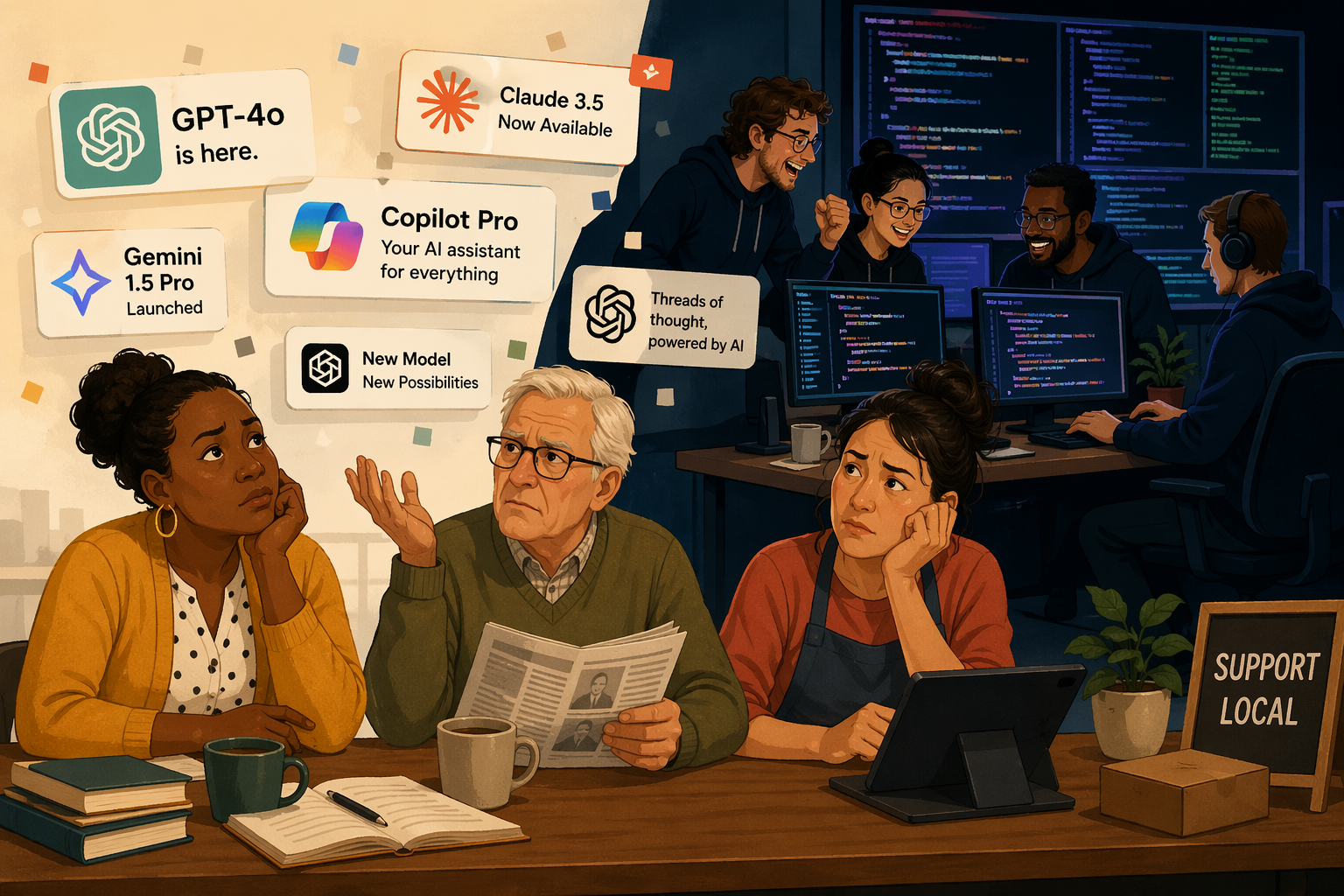
In this episode I do a brief rundown of the biggest AI releases and updates from the past few weeks, fully through the lens of who is all this AI actually for, and whether you actually need to care. I cover usage stats, new releases from Anthropic, OpenAI, Google, and Meta, and share my take on what all of this activity means for everyday users. Spoiler: most of these updates are for builders, coders, and developers, and folks like us would be better served focusing on learning how to most effectively use what already exists.
Who Is All This AI Actually For?
I’ve spent the past few episodes sharing more how-to’s and technical topics, so I figured I’d just let today’s episode be easy and serve up a state of the AI union that is largely my two pennies on what I think is actually worth being curious about.
New models keep being rolled out, and every week there’s a press release about some new something or other. I’m generally at least superficially aware of the big events and changes in the AI space because I spend way too much time on Threads, and I also subscribe to a handful of AI-focused newsletters.
For those interested, here are my top five AI-focused newsletters/blogs, in no particular order:
- Benedict Evans’ Newsletter
- Handy AI by Jake Handy
- Andy Masley
- Future-Proof Your Career with AI by Khe Hy
- Confluence: AI, Leadership, and Communication by CRA
So, gonna kinda start with the conclusion here and then we’ll jump into the data and the details.
Who exactly are all of these AI developments actually for? Simply stated: Builders, coders, and developers.
Technically, I guess one could argue that the developments are actually for owners and shareholders who are ultimately looking to turn a profit on their investments, but as it relates to users most impacted by these developments, it is builders, coders, and developers.
In my humble opinion, the average user definitely doesn’t need to concern themselves with any of these advances, nor do I think they’ll even notice a change. For aspiring vibe coders and curious folks like yourself, some of these advances might be interesting, but IMO, none are actually necessary. These models are already incredibly capable and fully able to meet our needs.
But let’s get into some data and details and see what’s been going on over the past few weeks.
AI Use Overview: The Numbers
Who’s using what, and how much are they using it?
I take all data with a very very big grain of salt, but here’s the breakdown of daily active users on US mobile apps, from the most recent comparable data:
- ChatGPT: 45.3%
- Gemini: 25.2%
- Grok: 15.2%
- Copilot, Perplexity, DeepSeek, and Claude collectively splitting the remaining ~14%
Yup, Claude is way down at the bottom. Remember, this data is looking at the average user, aka folks using LLMs to ask for recipes once a week and pretty much nothing else.
As for actual numbers of users, exact numbers were very hard to come by (this is by design), but this is what I found:
- ChatGPT hit 900 million weekly active users as of February 2026
- Google’s Gemini hit 750 million monthly users, making it the fastest-growing platform right now
- Claude has about 18.9 million monthly active web users (If you, like me, have Claude as your daily driver, pat yourself on the back. Welcome to the super cool kids club.)
Worth noting: Hopefully you caught that some of those numbers are reported in weekly average users, and others in monthly. These companies stay being intentionally shady and confusing with their reporting. I tried to dig and find data about paid vs. free users and honestly, it’s pretty much impossible to find anything.
On Pricing: Get Ready
To me, the lack of transparency when it comes to reporting continues to be fully worth flagging and should keep users both skeptical about all of these AI companies and also fully prepared for pretty much anything to happen. It’s pretty much a mathematical certainty that we’ll start seeing something directly out of Uber’s playbook. Translation: increased prices.
There are already rumblings and rumors about Anthropic removing Claude Code from the $20 pro tier, at least for new users, which would mean they’d need to bump up to at least the 5x Max plan which costs $100/month.
OpenAI hasn’t unbundled things yet, but they did begin testing ads on the free and go tiers in early February.
All that to say: expect changes in pricing and user experience. It’s only a matter of time.
Anthropic Has Been Busy
So, about those roll-outs and releases. Let’s start with Claude, because Anthropic has been bizzzzay.
Opus 4.7 dropped on April 16th and received mixed reviews. Apparently it’s stronger on coding, better with reasoning, and built for longer, more autonomous tasks. Buuuuut, here’s also a cost issue worth naming: they changed the tokenizer and it burns up to 25% more tokens per task. Translation: It’s more capable but way more expensive.
Have I used it? Nope. Sonnet 4.6 is my daily driver AND my go-to model for vibe coding vibe. And for those of you who have no idea what I’m talking about, yes, you can select what model you want to use with Claude (Sonnet 4.6, Sonnet 4.5, Opus 4.7, Opus 4.6, Opus 3, Haiku 4.5). For context, ChatGPT simplified things considerably in early 2026 and now only has GPT-5.3 Instant, Thinking, and Pro. For those on a paid plan, ChatGPT uses an auto-switching router that picks Instant or Thinking based on query complexity and routes for you.
Claude Design launched on April 17th, and while I’ve yet to use it, it did make a splash while also receiving a fair amount of complaints (as is to be expected — these things are just doing complex math afterall). Claude Design lets you create visuals that can go straight to Canva, PDF, or PowerPoint. It’s built for people who aren’t starting from a design tool and need to get from an idea to something visual quickly.
Also in the launch streak: Claude for Word (which rounds out the PowerPoint + Excel trifecta) and a rebuilt Claude Code desktop app with multi-session support. (Insert MASSIVE eye roll at the latter given that literally just last week I did an entire episode about Claude’s Desktop app…only for them to go and revamp it.)
To me, the rollouts of Claude Design and Claude for Word speak to Anthropic’s efforts to make their tools more accessible, more useful, and easier to use by the average individual. Anthropic’s wheelhouse is definitely coding, as evidenced by the model rollouts, but these are clearly efforts to appeal to folks with less technical backgrounds.
OpenAI’s Superapp Moment
Over to OpenAI.
OpenAI has apparently built and launched a “superapp.” Spoiler: It’s giving Apple dropping a new release and all the green text folks saying, “We been had that.“
I’ve yet to try it (I’m all Claude all the time, baby), but based on my digging it appears to simply be OpenAI’s version of Claude Desktop, with fewer rules, a bit more power, and upgraded image generation.
This superapp is accessed via the Codex Desktop app (currently only available for Mac) and bundles ChatGPT, Codex, and OpenAI’s Atlas browser into a single desktop environment. Codex can now connect to your apps, control your desktop, edit presentations, run multiple AI agents in the background simultaneously, and browse the web.
Again, it really is just OpenAI’s version of Claude Desktop…with a bigger PR moment.
The other big recent rollout from OpenAI is GPT Image 2, which dropped on April 21st. OpenAI is calling it “a new era of image generation,” and, truth be told, it has actually been getting a lot of positive reviews from users. For the nerds in the audience: the positive reception is likely because it uses autoregressive models instead of the diffusion-based approach that powered DALL-E and Sora, which means more accuracy, more detail, more control, and fewer mistakes.
Speaking of Sora, OpenAI opted to shut the app down due to unsustainable computing costs. Web and app experiences will end on April 26th. Good riddance.
Google and Meta: Brief and On-Brand
Gonna keep this section brief because there honestly really isn’t much to say, but it does support the premise of this episode: these rollouts are for builders, coders, and developers.
Google dropped Gemini 3.1 in February and Meta dropped Llama 4 Maverick, both of which are competitive with GPT-5.4 on all those coding and reasoning benchmarks that folks like you and me don’t actually understand or care about. Google did also release a native desktop app for Gemini, currently available only for, you guessed it, Mac.
Something that actually is worth noting and caring about: NotebookLM now lets you export slides as fully editable PowerPoint files! Google NotebookLM is one of my favorite AI tools and is definitely worth checking out if you haven’t already. I did a full breakdown of Google NotebookLM in episode 25 which you can check out here. The ability to export and edit the slides it makes is a huge upgrade and I wish it was getting more press.
Lastly, I’m not even gonna get into Grok because fuck Elon and fuck Trump, so that, my friends will round out the information portion of this state of the AI union.
What I Actually Want You to Take Away
I realize I shared a lot of numbers and decimal points with you, but there are some overarching themes that I was hoping to convey:
- All of this AI and all these updates are largely for coders, developers, and builders.
- As is always the case, the big AI players are all doing the same thing, and which LLM you use is largely just a matter of personal preference (many folks are using multiple models).
- These companies are exactly that: companies. They’re running businesses, which means they are first and foremost concerned with money. Get ready to start feeling that.
- Folks like you and me don’t need better models. Right now we’d be best served to simply focus on most efficiently using what currently exists and really leaning into building what I’ll call “personal helper tools” if vibe coding is in the cards.
How I Used AI This Week
Each episode I share a quick example of how I used AI that week.
Speaking of personal helper tools: Last week I used Claude Code to vibe code a personal web app that allows me to edit and save fillable PDFs directly inside of Google Drive. Fun fact: I also made said fillable PDF using Claude a few months ago.
Prior to building this personal web app, I was using a tool called DocHub, but that only gave me 3 free docs and then it charged $16/month for a ton of features I didn’t need. Immediately no. I literally just needed to be able to edit and save those fillable PDFs inside of Drive.
So I hit up my French assistant, Claude, and in about 2 hours we had a fully-functional, fully-Maestrofied DocHub dupe. Worth mentioning, integrating it with Google Drive was much easier this time because of the familiarity I’ve gained through other builds.
I’ve already used it a few times a week, it’s exactly what I need, and it’s free. Big win.
Da Wrap-up
All the AI activity you’re seeing right now, the model drops, the product launches, the pricing shifts, it’s largely for builders, coders, and developers. The average user defffffinitely doesn’t need to concern themselves with any of it. For curious folks like you and me, what is worth your time is figuring out how to use what already exists more efficiently and, if vibe coding is in the cards, leaning into building the personal helper tools that actually solve your specific problems.
As always, endlessly grateful for you and your curiosity.
Catch you next Thursday.
Maestro out.